
Mainsail — Operational Resource Scheduling
Every aircraft. Every crew.
One live schedule.
Mainsail keeps your fleet, crews, and ground operations synchronized in real time — with conflict detection, duty & rest compliance, and disruption tools built for the way flight operations actually run.
01 — The problem
Operations don’t run on spreadsheets.
Most operations are coordinated through a patchwork of spreadsheets, whiteboards, and phone calls that were never designed for resource-constrained scheduling. The failures are predictable.
Double-booked resources
The same tail, the same crew, two assignments — discovered at the worst possible moment.
Invisible knock-on delays
One late leg quietly breaks every assignment that follows it, and nobody sees it coming.
No single source of truth
Who is assigned where, right now? Every answer requires a phone call and a little faith.
Change you can’t model
Pulling an aircraft for maintenance shouldn’t be a guess about what it will break downstream.
02 — The platform
Your whole operation, on one timeline.
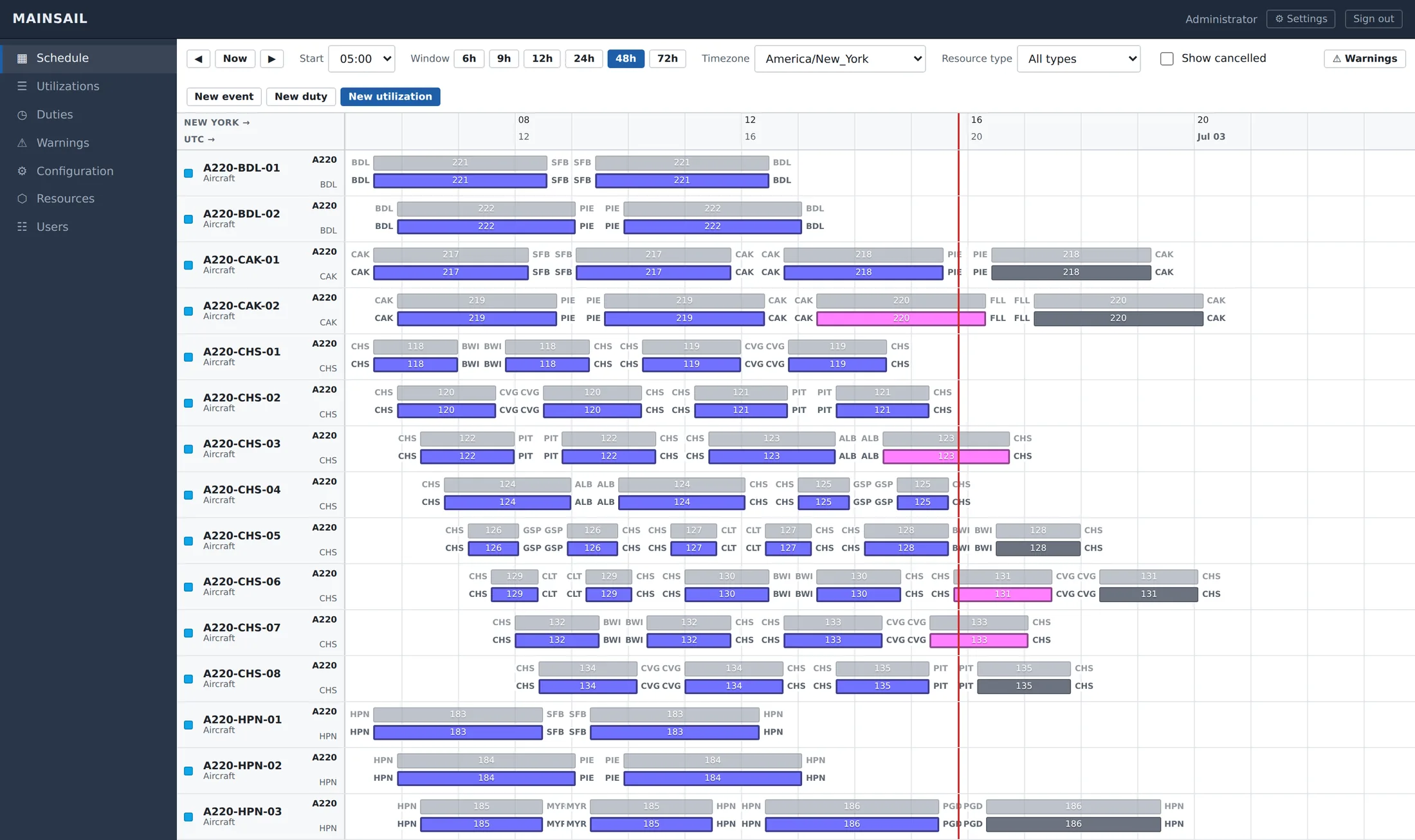
Every resource gets a row. Every assignment, duty period, and disruption lives on a live, color-coded Gantt board that updates for your entire team in real time — no refresh, no radio check.
Plan vs. reality
See slippage the moment it starts
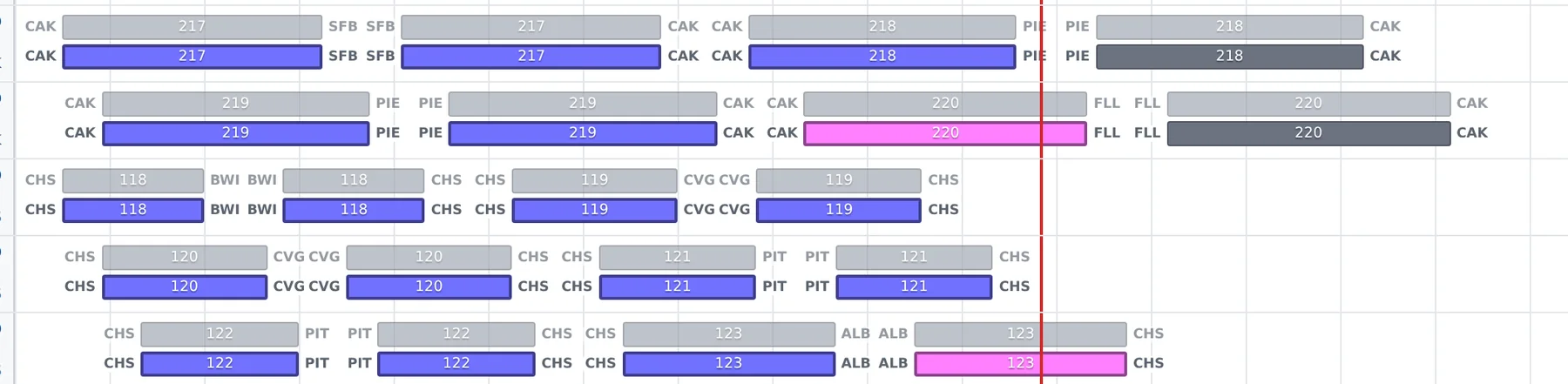
Every assignment tracks three layers of time — scheduled, estimated, and actual — for every milestone you define. The plan of record stays as a ghost bar above the live one, so a slipping leg is visible at a glance, and bars escalate their styling as work runs overdue.
- Scheduled / estimated / actual on every time point
- Status-driven colors you configure per activity type
- Any window from 6 to 72 hours, in any timezone
The warning engine
Conflicts surface themselves
Every change is checked against always-on integrity rules: double-bookings, legs that start where the aircraft won’t be, work scheduled over maintenance, unfilled crew slots, closed locations, and crew working outside a duty period. Warnings stream to every signed-in user over websockets and link straight to the affected assignment on the board.
- Blocking vs. advisory severity, filterable in one live feed
- A blocked leg reveals its full downstream ripple automatically
- Click a warning to jump to the exact spot on the schedule
Rules without code
Your limits, in plain English
Duty-time ceilings, block-hour totals over rolling windows, minimum rest, qualification matching, occupancy limits — build them all in a visual editor that reads the rule back to you in a plain sentence. Run planning rules against scheduled times so a late actual never rewrites yesterday’s compliance.
- Aggregate, rest, qualification, occupancy, and per-record rules
- Tiered rest requirements and rolling or calendar windows
- Toggle rules safely — every change triggers a full re-check
Disruption management
When the day goes sideways, act in one click
Delay a leg with new estimates without touching the plan of record. Divert an in-progress flight or return it to origin. Swap equipment or crew in place. Cancel and reactivate with full context preserved. Every action re-checks the whole schedule the moment you commit.
- Delay, divert, return, swap, and cancel as first-class actions
- Diverts are data — estimated and actual locations, not sticky notes
- Cancelled work stays visible for context, without tripping rules
03 — Capabilities
Everything an ops platform should carry.
Your operation, your vocabulary
Define locations and gates with operating hours, resource types with custom fields, activity types with their own milestones and crew slots, duty types, and disruption categories. No code, no consultants.
Three-layer time tracking
Scheduled, estimated, and actual values on every milestone and location. The board, the rules, and the warnings all resolve to the best truth available.
Granular access control
Permission groups govern who can view, schedule, configure, and administer — enforced in the interface and the API alike, with hardened, revocable sessions.
Real-time everywhere
Schedule edits and warnings push instantly to every signed-in browser. Your dispatcher, your planner, and your chief pilot are always looking at the same picture.
A real API
Every entity in Mainsail is available over a typed REST API with validated contracts — ready for integration with dispatch, maintenance, or ERP systems.
Your cloud, your data
Mainsail deploys single-tenant into your own AWS account with infrastructure as code — a dedicated background worker keeps compliance checks from ever slowing the ops floor.
04 — Built for flight operations
Born on the flight line.
Mainsail was built around the realities of running a fleet: tail swaps at 6 a.m., diverts that reshuffle an afternoon, crews bumping against duty limits, and turnarounds measured in minutes. The schedule thinks in legs and locations. The rules engine speaks block hours and rest periods. The board shows your day in dual timezones, the way dispatch already reads it.
Regulatory duty & rest limits — tiered rest, rolling flight-time totals, compensatory rest — can be encoded exactly as written and checked continuously against the live schedule, not reconstructed after the fact.
Not just aviation
The core is deliberately domain-agnostic. If your operation assigns crews and equipment to time-bounded work across locations — vessels, vehicles, field teams — Mainsail models it without a line of code.
- Dual-timezone timelinebuilt for dispatch
- Duty & rest ruleschecked on every edit
- Location continuityevery leg, every turn
05 — Getting started
Scheduling live in days, not months.
Model your operation
Guided onboarding to configure your locations, resource types, activity types, and custom fields — your terminology from day one.
Bring your schedule
We help migrate your existing schedule into Mainsail so the board is real from the first sign-in.
Set your roles
Role setup ensures dispatchers can act, planners can see, and administrators stay in control.
Go live — and connect
Run daily ops on the live board, then integrate dispatch, maintenance, or ERP systems through the REST API.
Ready when you are
See Mainsail on your operation.
Tell us about your fleet and your day — we’ll walk you through Mainsail configured for the way you run.